
A new long-haul monster has just made Australia feel a little less far away.
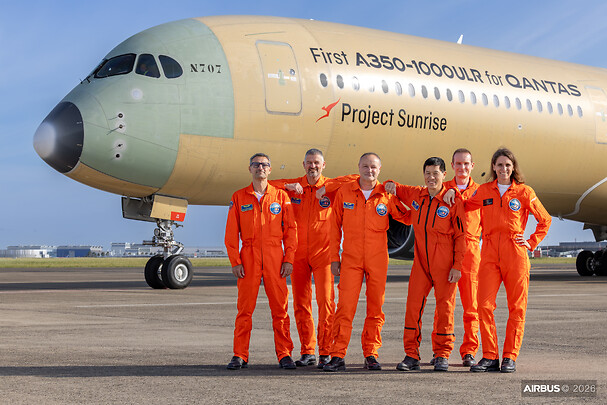
Image: Airbus / Qantas Project Sunrise A350-1000ULR flight test aircraft.
Qantas' Airbus A350-1000ULR test aircraft has landed in Melbourne after a non-stop flight from Toulouse, France, marking a major Project Sunrise milestone and giving Australia its first proper look at the aircraft built for future Sydney to London and Sydney to New York services.
This was not a normal delivery flight with a shiny cabin and a press pack in every seat. It was a working test mission: an Airbus-operated aircraft, still deep in certification work, crossing almost 17,000 km to prove that the hardware, fuel system, cabin systems and operating concept can survive the sort of mission Qantas wants to sell to passengers from 2027.
For aviation fans, it was a spectacle. For Qantas, it was a proof point. For sim pilots, it is a glimpse of the kind of ultra-long-haul flying that will soon become less theoretical and more routine.
The flight: Toulouse to Melbourne in one hit
The aircraft involved is Airbus MSN707, registered F-WULR, the first A350-1000ULR built for Qantas' Project Sunrise programme. It departed Airbus' final assembly home in Toulouse and flew direct to Melbourne, touching down on 24 July 2026 after roughly 19 hours and 12 to 13 minutes in the air, depending on the timing source.
That route is the sort of line on a map that still looks slightly silly: southern France to south-eastern Australia without a fuel stop. Around 17,000 km of ocean, desert, airways, weather decisions and fuel planning, all wrapped into one continuous sector.
This is why the flight grabbed so much attention online. Aviation trackers lit up as the aircraft crossed hemispheres, moving from European summer into Australian winter in a single leg. The novelty was not just the distance; it was seeing a near-future airline operation being rehearsed in public.
Qantas has been talking about Project Sunrise for years, but this flight made the idea physical. A real airframe, real fuel, real crews, real systems data, and a real touchdown in Melbourne.

Image: Qantas Project Sunrise A350 exterior concept.
Track the Toulouse to Melbourne route
The public tracker identifiers for the flight were AIB35LR, registration F-WULR, hex 39A3FB. AeroMesh did not capture a local historical track for this aircraft, so there is no BML/AeroMesh replay for the full sector, but the flight can be looked up on public tracking sites:
- Flightradar24 flight replay: AIB35LR / 40ce0e1e
- ADS-B Exchange trace for 39A3FB on 23 July 2026
- Aviation Flights MSN707 activity log
These links are better treated as tracker replays rather than an official filed flight plan: they show the aircraft track that was publicly visible, not necessarily every ATC waypoint filed before departure.
What makes the A350-1000ULR different?
The A350-1000ULR is not just a normal A350-1000 with a more ambitious route map printed on the brochure. Airbus has developed the ultra-long-range variant around Qantas' need to connect eastern Australia with Europe and the US east coast without a stop.
The headline change is the additional rear centre tank, adding around 20,000 litres of fuel capacity and increasing the aircraft's range by roughly 1,000 nautical miles. Airbus says the aircraft is intended for sectors approaching 10,000 nautical miles, with flight times of up to 22 hours.
That extra range has to be certified properly, which is why MSN707 is carrying extensive flight test instrumentation. Airbus has described more than a thousand sensors and a production-aircraft test setup designed to validate the new fuel system, cabin temperature control and galley cooling architecture without ruining the aircraft for later airline service.
That last bit matters. This is not a disposable prototype. Once the test campaign is complete, MSN707 is expected to be refitted to Qantas' commercial specification.
Why Melbourne matters
Melbourne is not the first planned Project Sunrise launch route. Qantas' headline plan remains Sydney to London from October 2027, with Sydney to New York expected to follow.
But Melbourne getting the test arrival is still useful symbolism. It shows Qantas wants the aircraft to be seen as more than a Sydney-only project. Melbourne and Brisbane have both been discussed as future non-stop candidates once more aircraft arrive and demand justifies the flying.
The bigger picture is that Qantas is trying to redraw the Kangaroo Route again. What used to be a multi-stop endurance test gradually became a one-stop journey through hubs such as Singapore, Dubai or Perth. Project Sunrise is the next step: Australia to Europe or New York without the intermediate landing at all.
That saves time, but it also changes the passenger experience. There is no halfway reset. No walking through a terminal. No new crew boarding. No pause in the cabin rhythm. The aircraft has to become the journey.

Image: Qantas A350 cabin layout concept for Project Sunrise.
The cabin challenge is as big as the range challenge
A 22-hour aircraft is not judged only by whether it can carry enough fuel. It is judged by whether people can stand being inside it.
Qantas has chosen a deliberately low-density layout for these aircraft: 238 seats across four cabins. That is far fewer than many airlines would put into an A350-1000, and it reflects the unusual mission. The airline is planning first class, business, premium economy and economy, plus a wellbeing zone intended to give passengers somewhere to stretch and reset during the flight.
The comfort work is not just soft branding. Qantas has been working with sleep and circadian researchers on lighting, meal timing and cabin routine, because a non-stop London to Sydney or Sydney to New York flight is basically a rolling jet-lag experiment with wings.
For pilots and dispatchers, the challenge is more technical: payload, winds, alternates, crew duty planning, fuel reserves, cabin systems, routing and the economics of carrying enough fuel to avoid a stop while still making money.
That is what makes this aircraft interesting. It sits right at the edge of what commercial aviation can do every day, not just once for a record attempt.
Why sim pilots should care
BeatMyLanding is built around the last few seconds of flight, but this aircraft is a reminder that the landing is only the final line of a much longer story.
An ultra-long-haul arrival after 19 or 20 hours is a different kind of discipline. The aircraft is lighter than it was at departure, the crew has been managing energy and automation for most of a day, and the arrival still has to end with a stable approach, correct speed, sensible flare and a touchdown that does not waste the whole mission.
For flight simmers, Project Sunrise routes are going to be tempting. Toulouse to Melbourne, Sydney to London, Sydney to New York, Melbourne to London: they are the sort of flights people will stream, track and attempt as endurance challenges. The trick is not just getting airborne and leaving the autopilot alone. The trick is arriving sharp enough to fly the last 1,000 feet properly.
That is where BML makes the story more fun. If you spend a whole day crossing the planet, the landing score suddenly feels personal.
What happens next?
The Melbourne flight is part of Airbus' wider certification campaign for the A350-1000ULR. Airbus has said the test programme covers the aircraft modifications needed for ultra-long-range service, including the extra tank and cabin-system changes.
Qantas has ordered 12 A350-1000ULR aircraft for Project Sunrise, with the first commercial-spec delivery now expected in April 2027. The airline is aiming to begin Sydney to London non-stop services in October 2027, with Sydney to New York following later.
There are still practical questions to answer: ticket pricing, passenger tolerance, crew agreements, reliability, payload performance in awkward winds, and how often customers will pay more to skip the stop. But the hardware has moved from concept art to long-range test flights, and that is a big shift.
Bottom line
The A350-1000ULR landing in Melbourne was more than a long ferry flight. It was a public rehearsal for a new kind of airline route, one where Australia reaches Europe and the US east coast without touching down halfway.
For Qantas, it is Project Sunrise getting closer to the runway. For Airbus, it is proof that the A350 platform still has room to stretch. For aviation fans, it was a rare chance to watch a future world-record commercial aircraft do something genuinely dramatic.
And for sim pilots? It is another challenge for the logbook: fly halfway around the world, then still make the landing count.
FAQ
What aircraft flew from Toulouse to Melbourne?
The flight was operated by Airbus A350-1000ULR MSN707, registered F-WULR, the first ultra-long-range A350-1000 built for Qantas' Project Sunrise.
How long was the A350-1000ULR test flight?
The flight took just over 19 hours, widely reported at around 19 hours and 12 to 13 minutes from Toulouse, France to Melbourne, Australia.
Why is the Qantas A350-1000ULR special?
It is fitted with an additional rear centre fuel tank and other changes designed for flights of up to 22 hours, enabling future non-stop routes such as Sydney to London and Sydney to New York.
When will Project Sunrise passenger flights start?
Qantas is targeting October 2027 for Sydney to London non-stop passenger services, with Sydney to New York expected to follow.
How many seats will Qantas put on the A350-1000ULR?
Qantas plans a low-density 238-seat layout across four cabins, designed around ultra-long-haul comfort rather than maximum seat count.
Sources
- Qantas News Room: Project Sunrise test aircraft to touch down in Australia
- Airbus: A350-1000ULR takes to the skies
- Airbus: Flight testing the A350-1000ULR
- Qantas News Room: Australia to the world, non-stop
- AeroTime: Qantas ultra-long-range A350 lands in Melbourne after 19-hour flight
- The Guardian: Qantas tests new ultra long-range Airbus in 17,000km direct flight